How are hollow bricks produced? A complete guide to the hollow brick production process.
Hollow bricks are a common walling material in modern construction, widely used in residential, commercial, and industrial buildings, as well as infrastructure projects. For enterprises planning to invest in a hollow brick production line, understanding the complete manufacturing process helps in making informed choices regarding production equipment, capacity planning, and quality control.
So, how exactly are hollow bricks produced? The journey from raw materials to finished products typically involves several key stages: raw material preparation, proportioning, mixing, material feeding, vibration molding, curing, and final product handling.
I. Raw Material Preparation
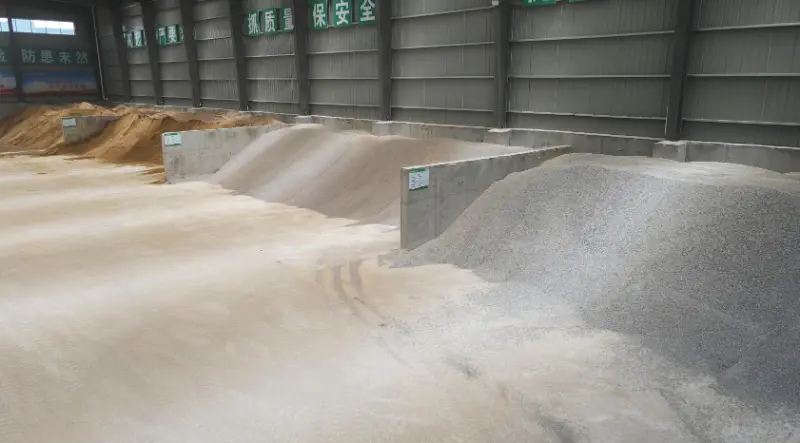
Hollow bricks are typically made using primary raw materials such as cement, sand, stone dust, and aggregates. Depending on local resource availability, suitable solid waste materials—such as fly ash, mineral powder, steel slag, and construction waste—may also be incorporated.
The particle size distribution, moisture content, and properties of the various raw materials directly influence the strength, density, and surface quality of the concrete blocks. Therefore, selecting and processing raw materials appropriately based on specific product requirements is essential to the production process.
II. Precision Batching
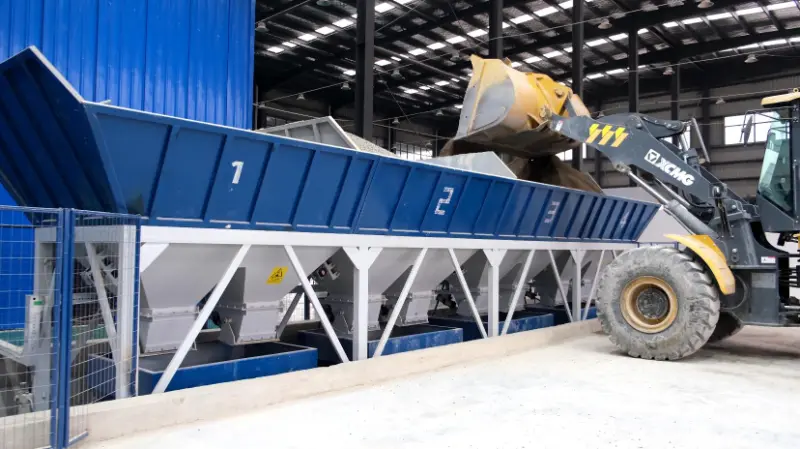
Once the raw materials are prepared, they enter the concrete batching system.
The batching equipment accurately measures cement, sand, stone, and other aggregates according to preset formulas and conveys them to the mixing equipment in the specified proportions.
Consistent batching ratios are fundamental to ensuring uniform quality in hollow bricks. In large-scale production, automated batching not only boosts efficiency but also helps minimize ratio errors caused by manual operation.
III. Thorough Mixing
Once the ingredients are prepared, the raw materials are fed into a concrete mixer for thorough blending.
The primary purpose of mixing is to ensure the uniform distribution of cement, aggregates, water, and other materials, creating a mixture suitable for block molding.
Proper mixing time and techniques enhance the mixture’s homogeneity, thereby providing consistent raw material conditions for the subsequent material feeding and molding stages.
IV. Precise Material Feeding
The mixture is then transferred to the feeding system of the block molding machine.
This system evenly fills the mold cavities with the concrete mixture. In the case of hollow bricks, the mold determines not only the product’s length, width, and height but also the shape and number of voids, as well as the overall structural design.
Consequently, the block mold is a critical component of the hollow brick production process. Molds of various specifications can be configured to meet the demands of different markets and construction projects, enabling the production of a diverse range of products.
V. Vibration and Press Molding
Following the material feeding stage, the process moves to the core phase: vibration and press molding.
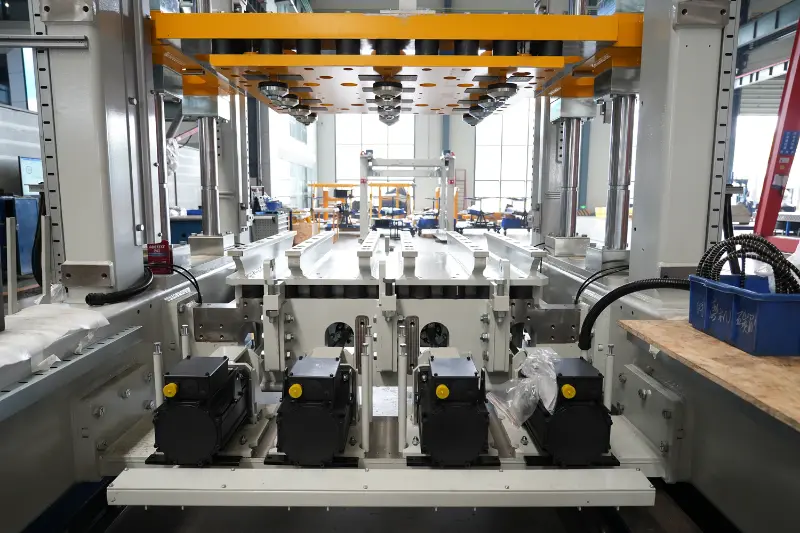
The molding equipment utilizes the combined action of vibration and pressure to rapidly densify the concrete mixture within the mold and form a stable hollow brick structure.
Factors such as the vibration system, molding pressure, molding duration, and mold precision directly influence the product’s density, dimensional accuracy, strength, and surface quality.
Therefore, for concrete block machines, reliable vibration molding technology serves as the essential foundation for the large-scale production of high-quality hollow bricks.
For enterprises looking to build modern hollow brick production lines, key factors to consider when selecting equipment include the level of automation, molding technology, mold compatibility, and production stability.
SUOTENG offers automated concrete block production equipment and comprehensive solutions. We configure production lines and mold setups tailored to specific product specifications, capacity requirements, and local raw material conditions, meeting the production needs for a wide range of concrete products—including hollow bricks, solid bricks, paving stones, and curbstones.
If you are planning a hollow brick production project, we recommend first determining the product specifications and daily output targets for your target market, and then selecting the appropriate concrete block production equipment based on those specific needs.